



From Drawing Board to Waterslide: When Canadian Patent Rights Apply
Proslide Technology Inc. v. Whitewater West Industries, Ltd., 2026 FCA 59
In a decision released earlier this year, Canada’s Federal Court of Appeal (“FCA”) weighed in on the patent dispute between ProSlide Technology, Inc. (“ProSlide”) and WhiteWater West Industries, Ltd. (“WhiteWater”), two of the world’s largest developers and manufacturers of waterslides. The FCA allowed ProSlide’s appeal in part, overturning the Federal Court’s (“FC”) conclusion that ProSlide’s asserted claims were invalid for overbreadth, but also confirming that WhiteWater had not infringed those claims in Canada.[i]
The FCA Decision is notable for the following reasons:
- the FCA affirmed that domestic product development and design activities based on a competitor’s patented products do not, on their own, constitute patent infringement, if the manufacture, assembly, or use of the physical invention occurs outside Canada; and
- the FCA reaffirmed that a claim can be invalid for overbreadth if it claims more than it describes or more than the inventor has made. However, the FCA emphasized that the strongest evidence as to what was made or invented are the contents of the patent specification.
Background
Between 2009 and 2020, ProSlide applied for and obtained four Canadian patents relating to waterslides. The slides were conceived by Richard Hunter, ProSlide’s President and Chief Executive Officer, who claimed it was inspired by his experiences with downhill skiing and his desire to develop a slide where the rider has an opportunity to see where they are going.[ii]
One of the slide designs incorporated an open-air, saucer-shaped section where the rider exits an enclosed tube and compasses the saucer by sliding along, or “riding,” its sloped outer wall before exiting the saucer through a second enclosed tube.
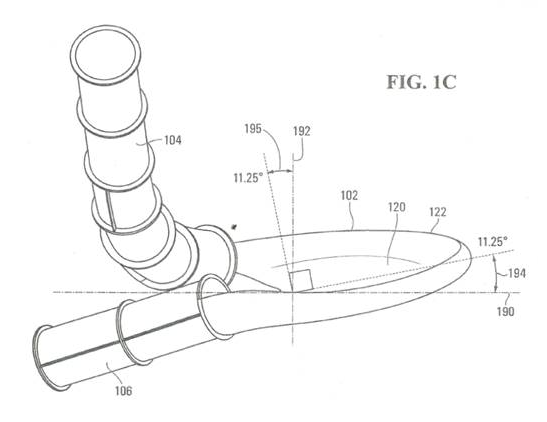
WhiteWater began manufacturing and selling similar waterslides.[iii] Although WhiteWater conducted research and development for the products within Canada, the slides were only manufactured, assembled, and sold outside of the country.
ProSlide commenced litigation for patent infringement against WhiteWater in multiple jurisdictions, including Canada. WhiteWater denied any infringing actions in Canada and asserted the ProSlide patents were invalid.
Analysis
- Infringement: Product Design and Development Activities May Not, On Their Own, Constitute Infringement
At trial, WhiteWater argued that it could not have infringed ProSlide’s Canadian patents because all manufacturing, assembly, and sales of the allegedly infringing products occurred outside of the country, and the development and design activities that did occur domestically did not constitute “use” of ProSlide’s patented product.
The FC accepted WhiteWater’s position, saying “[t]here is no basis in law to find that generating detailed computer-aided designs and mechanical drawings in Canada is ‘making’ the claimed invention, where the invention as claimed is for a physical object.”[iv] The FCA affirmed the FC decision on this ground.[v]
- Invalidity for Overbreadth: What Did the Inventor Invent Anyway?
Under Canadian law, the claims must not be broader than what was made or contemplated by the inventor. WhiteWater alleged that ProSlide’s patent claims were invalid because they were broader than what was contemplated by Richard Hunter during product development. In support of this allegation, WhiteWater pointed to extrinsic evidence of Mr. Hunter’s intentions prior to filing the patent application, including email communications as well as Mr. Hunter’s own testimonial evidence recounting the inspiration and development of the invention.
The FC had accepted WhiteWater’s argument and found ProSlide’s claims to be broader than what was made or contemplated by Mr. Hunter. The FC had pointed to four “key aspects” of the invention that were omitted from the claims,[vi] including that the invention was apparently intended by Mr. Hunter to be a waterslide, but the claims extended to amusement rides generally.
On appeal, the FCA overturned this conclusion.[vii]
The FCA confirmed that claims being broader than the invention made or contemplated, as distinguished from what was disclosed, remains a valid ground of invalidity in Canada.[viii] However, the FCA emphasized that the most reliable evidence as to the invention made or contemplated is the contents of the specification itself. In this case, the specification explicitly stated that the four elements flagged by WhiteWater and the FC were not essential to the invention.[ix]
The FCA stressed that, while evidence as to the inventor’s intentions may be relevant when determining whether the patent’s claims are overly broad, “it is difficult to imagine a more reliable (and more timely) indication of what the inventor contemplated than the patent specification”.[x]
The appeal was therefore allowed in part, and the validity of the disputed claims was restored.
Commentary
The FCA Decision is a good reminder for patent applicants of important considerations when drafting patent specifications and developing an IP strategy.
Three key takeaways:
- Patents are territorial. In this case, there was no dispute that WhiteWater was manufacturing products that incorporated the essential elements of ProSlide’s claims. However, the manufacture, assembly, and use of the product occurred outside of Canada, which did not infringe the territorially limited Canadian Applicants should consider filing for patent protection in jurisdictions where products will be manufactured and/or sold.
- The use of drawings, designs, and technical specifications does not, on its own, constitute “making” or “using” a claimed invention.
- The claims must not be broader than what was made or contemplated by the inventor. While extrinsic evidence may be considered, the invention made or contemplated should not be determined without reference to the features and possible variations explicitly indicated in the patent specification.
For assistance in developing IP strategy or patent drafting, please contact Gillian Burrell at info@pckip.com.

______________________________________________________________________________________
[i] 2026 FCA 59 (“FCA Decision”) at paras. 39 and 53.
[ii] 2024 FC 1439 (“FC Decision”) at para. 244.
[iii] FC Decision at para. 3.
[iv] FC Decision at para. 121.
[v] FCA Decision at para. 53.
[vi] FC Decision at paras. 251-52.
[vii] FCA Decision at para. 39.
[viii] FCA Decision at para. 34.
[ix] FCA Decision at para. 37.
[x] FCA Decision at para. 36.
PCK Intellectual Property is a leading North American intellectual property law firm based in Canada, specializing in the preparation, prosecution, registration, enforcement, and strategic management of patent and trademark portfolios for global markets. Our team of seasoned patent agents, trademark agents, engineers, scientists, and IP lawyers supports clients across diverse technologies, with expertise in trademark law, trademark registration in Canada, trademark applications, trademark prosecution, trademark opposition proceedings, trademark portfolio management, trademark protection and enforcement, brand protection strategy, coordinating cross-border IP strategies including PCT national phase filings, Madrid Protocol trademark registration, and international patent filing in Canada. Whether you are a startup seeking IP strategy guidance, an inventor exploring how to protect an idea in Canada, or a US or foreign company looking to expand IP protection to Canada, contact us today to explore how we can help secure and manage your intellectual property.
The contents of this article are provided for general information purposes only and do not constitute legal or other professional advice of any kind.