


Recent CIPO guidance on patentable subject matter has prompted renewed discussion, and others have already begun to analyze its implications . While the guidance reflects an effort to clarify the analysis, it does not resolve the underlying structural tension. Rather than revisiting that guidance, this post focuses on a more persistent structural issue underlying software patentability.
In Canada and the United States, the controversy over software patent eligibility flows from a structural mismatch: an inherently unstable distinction between the abstract and the concrete is pressed into service as a binary, ostensibly objective question of law, even though in practice it is resolved through the intuition of the decision-maker rather than an evidence-based analysis.
The Human Level – Defining Abstract vs. Concrete
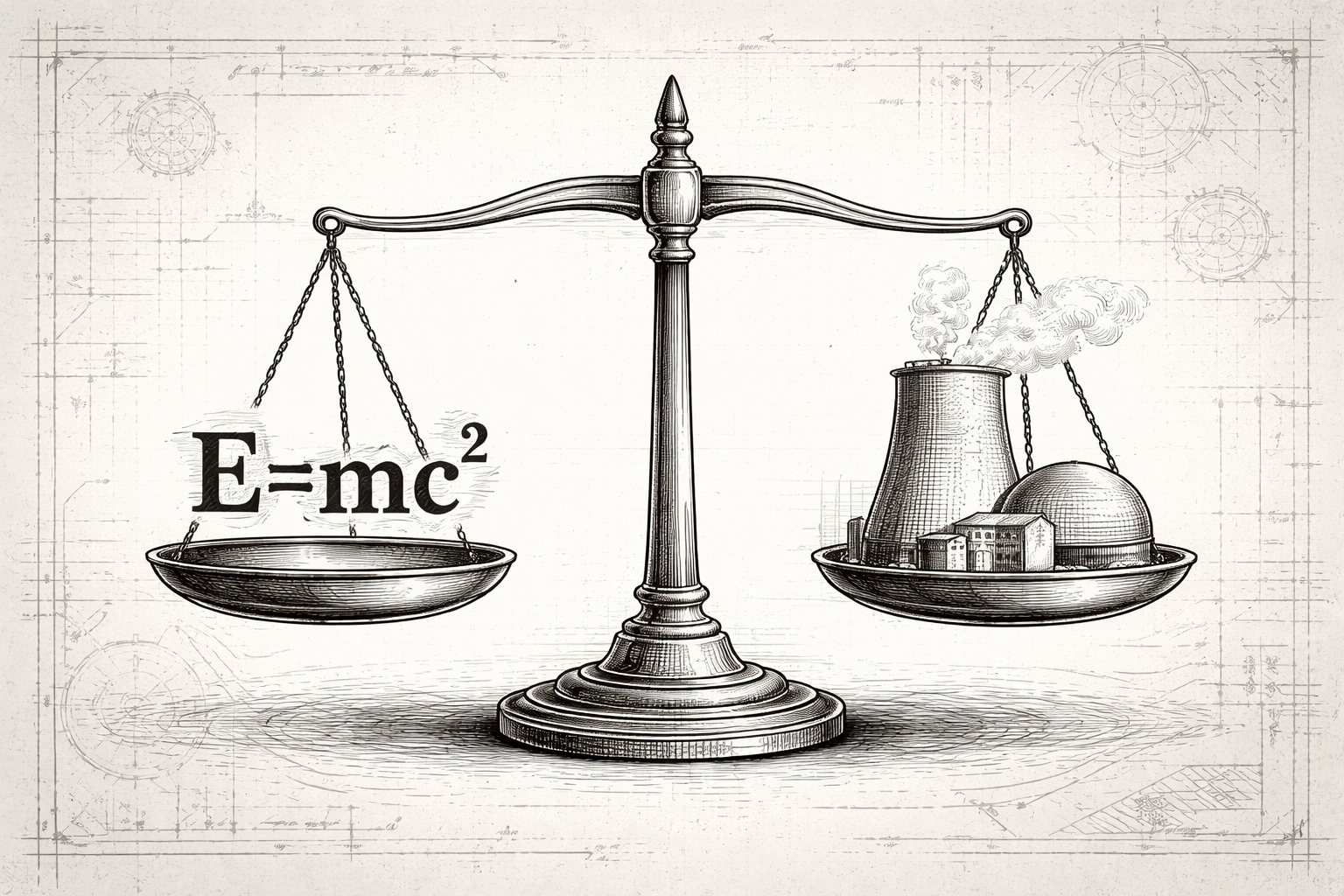
At a human level, well beyond legal doctrine, the distinction between “abstract” and “concrete” is intuitive yet inherently open to subjective interpretation. Clear cases exist at either end of the spectrum: a scientific principle such as E=mc² is readily understood as abstract, while a nuclear reactor is readily understood as concrete. But many software innovations sit between these poles.
To elaborate, an algorithm may be expressed as a mathematical idea, yet when implemented on a processor it can reduce computation time, energy consumption, or memory usage. Whether such an improvement is characterized as an “abstract idea” or a “concrete technological advance” depends not only on the invention itself, but on how it is framed, and from whose perspective it is assessed. For example, replacing an O(n²) bubble sort with an O(n log n) tree-based sort clearly improves processor performance in practice, yet the improvement can still be described at a high level as an abstract algorithmic change.
The result is not a binary distinction, but a continuum. The classification of any given invention depends on the level of abstraction, context, and framing. As a conceptual matter, the boundary between abstract and concrete resists stable definition.
The Patent Law Level – Confounding Statutory Language
The Statute of Monopolies was relatively clean, allowing for patents on “manufactures”. Subsequent statutory evolution in Canada and the United States introduced more exhaustive enumerations (e.g., art, process, machine, manufacture, composition of matter). To temper those headings, early statutory language also excluded “mere scientific principle[s] or abstract theorem[s]” from patentability, while leaving questions of novelty and merit to other provisions of the Act. The intent was to establish a bright line at the extremes: pure abstraction on one side, patentable invention on the other. A careful reading of those earlier versions of the Act makes that bright line clear (see Patent Act (R.S.C. 1906, c. 69), s. 7 and s. 2). Subsequent revisions have created opportunities to blur the lines between clean statutory subject-matter categories and tests for “inventiveness.”
Canadian jurisprudence has likewise demonstrated a willingness to adopt bright lines with categorical distinctions at the subject-matter level. In Harvard College v. Canada (Commissioner of Patents), for example, the Supreme Court drew a clear boundary between patentable and non-patentable subject matter based on a strict definitional reading of s. 2 categories, without canvassing concepts such as “invention”.
These bright-line approaches function effectively where the categories are stable. A scientific principle can be excluded without difficulty. The difficulty arises when that same categorical framework is applied to subject matter—such as software—especially when layered onto hardware (a “machine”) that does not fit neatly within either category. The problem is further confounded by the phrase “new and useful” being embedded directly beside the categories of invention in s. 2, inviting those considerations into the interpretation of the breadth of the categories.
Layering human intuition about what is “abstract” versus “concrete” onto this confounding statutory language leaves decision-makers relying on instinct to determine whether a claim is, in substance, concrete or abstract. Yet that reliance on intuition sits uneasily with the expectation that the law produces objective, predictable outcomes.
A More Stable Path: Europe’s Inventive Step Framework
In contrast to the instability observed in Canada and the United States, European practice has taken a different path, which has been stable since the early 2000s. Computer-implemented inventions are addressed primarily through inventive step rather than through an expansive subject-matter inquiry.
Under this approach, non-technical aspects of a claim are identified and ignored, and the analysis focuses on whether the remaining technical contribution is non-obvious in view of the prior art. The result is often perceived as strict. However, it has also proven to be relatively stable and predictable over time.
Importantly, this framework imposes discipline on the decision-maker. The analysis is anchored in prior art, structured reasoning, and an evidentiary record, rather than turning on an intuitive characterization of whether the invention is “really” abstract or concrete.
A Canadian Path to the Same Discipline
Canadian law already contains the tools to support a similar allocation of the problem.
A principled approach would begin with a bright-line subject-matter analysis, consistent with the historical exclusion of “mere scientific principle[s] or abstract theorem[s].” That analysis would perform its intended function of excluding clear cases of pure abstraction, without attempting to resolve more granular questions.
The substantive evaluation of computer-implemented inventions would then occur under obviousness. Within that framework, Canadian jurisprudence already permits claims to be stripped of unnecessary verbiage (see Allergan Inc. v. Canada (Minister of Health), [2012] F.C.J. No. 906 at para. 137, 2012 FC 767 (F.C.), affd [2012] F.C.J. No. 1467, 2012 FCA 308 (F.C.A.), leave to appeal refused [2013] S.C.C.A. No. 31 (S.C.C.), citing Pozzoli SPA v. BDMO SA, [2007] F.S.R. 37 at paras. 14–21, [2007] EWCA Civ. 588 (C.A.)), allowing non-technical elements to be discounted in the analysis. The remaining technical contribution can then be assessed against the prior art in a structured, evidence-based manner.
This approach mirrors, in substance, the European practice of isolating and assessing the technical contribution of a claim, while remaining grounded in Canadian doctrine. It also has the practical advantage of greater alignment with European prosecution, which is often relevant for applicants operating across jurisdictions.
Where This Leaves Software Patentability
The structural difficulty identified at the outset does not disappear. The boundary between abstract and concrete remains inherently unstable.
However, reallocating the analytical work away from subject matter and into an evidence-based obviousness inquiry would impose discipline on the process. It would reduce the reliance on intuition at the subject-matter stage and provide a more structured basis for decision-making and appellate review.
In that sense, predictability may matter as much as doctrinal generosity. A stricter but more stable framework may be preferable to a more flexible approach that turns on individual characterization.
Takeaways
Canadian patent law already contains the doctrinal tools to support a more disciplined approach to software patentability.
Subject-matter analysis should be confined to a bright-line exclusion of pure abstraction, with the substantive evaluation of computer-implemented inventions occurring under obviousness.
Such an approach would improve predictability, align more closely with European practice, and reduce the reliance on intuition in an area of law where the underlying boundary resists stable definition.
In the final analysis, it may be helpful to view unpredictable legal tests through the lens of the patent bargain: not only to what extent a framework promotes software innovation, but whether ambiguity itself deters investment and disclosure—a reason to prefer an evidence-based approach over an intuition-driven one.

PCK IP is a leading North American intellectual property firm based in Canada, specializing in the preparation, prosecution, and strategic management of patent and trademark portfolios for global markets. Our team of seasoned patent agents, engineers, scientists, and IP lawyers supports clients across diverse technologies, with expertise in coordinating cross-border IP strategies. Contact us today to explore how we can help secure and manage your intellectual property.
The contents of this article are provided for general information purposes only and do not constitute legal or other professional advice of any kind.